|
Flow Research is
working on a first-ever Mass Flowmeter Series.
This series includes in-depth studies on three types of flowmeters that
measure mass directly:
-
The World Market for Coriolis Flowmeters, 7th Edition
-
The World Market for Thermal Flowmeters, 3rd Edition
(Now shipping!)
-
The World Market for Mass Flow Controllers, 4th Edition
It also includes a Core Study The
World Market for Mass Flow Measurement.
This Core Study also includes data on multivariable flowmeters.
The
thermal flowmeter study is now complete. It reveals the size of the 2022 market, within
input from 2023, including the market shares of all major suppliers, and
forecasts for the market through 2027.
Can
thermal flowmeters help reverse climate change? We think they can play a
big role. These cost-effective meters are ideally suited to measuring
greenhouse gas and other emissions. In our 2nd Edition study, published in
January 2018, we found that environmental awareness and the need for
Continuous Emissions Monitoring are driving growth in the thermal flowmeter
market. We found that environmental awareness and regulations are
continuing to drive this market in 2023.
 Environmental
awareness propels growth Environmental
awareness propels growth
The
new age of environmental awareness that has spawned the Kyoto Accord, the
Paris Agreement, and other greenhouse gas initiatives, has resulted in a
rewriting of the rules on measuring greenhouse gas emissions. There is now
a need and a demand to measure greenhouse gases in applications that
formerly may have gone unnoticed. Many of these applications present
opportunities for thermal flowmeters, including:
-
Measurement and recovery of landfill gas
-
· Ethanol distillation and refining
-
· Measuring emissions from steam generators, boilers, and
process heaters
-
· Biomass gasification from organic industrial waste and food waste
-
· Recovery of methane from coal mines
-
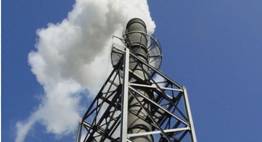
· Monitoring of flue gas
-
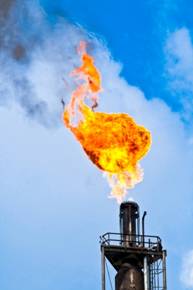
· Measurement and monitoring of flare gas flow
Thermal
flowmeters are uniquely suited to make these measurements because they can
accurately measure different mixtures of gases and because their insertion
technology allows them to handle large pipe sizes. Insertion thermal
flowmeters, for example, can measure two principal causes of acid rain --
sulfur dioxide (SO2) and nitrous oxide (NOx). They determine how much is
being released into the atmosphere by combining a measurement of the
flowrate with a measurement of the concentration of SO2 and NOx.
History
of thermal flowmeters
The
roots of thermal flowmeters go back to the hot wire anemometers that were
used for airflow measurement in the early 1900s, but thermal flowmeters
were first introduced for industrial applications in the 1970s. The story of how they came
on the market is a fascinating one.
We
tell this story in our new 3rd Edition study, drawing on in-person
interviews with the founders of the companies that first brought this
technology to market in the 1970s and early 1980s.
Thermal flowmeters as we
know them today were introduced for industrial applications in the 1970s.
are Fluid Components International (FCI), Kurz Instruments, and Sierra
Instruments are generally credited with introducing them to the market,.
Sierra Instruments and Kurz approached the subject through hot wire
anemometers. FCI approached the subject through flow switches. All three
companies were pioneers in the development of thermal flowmeters, and all
three companies still offer enhanced versions of these thermal flowmeters
today.
You
can find more information on the history and development of thermal meters
in Chapter 8 of New Technology Flowmeters, written by Dr. Jesse Yoder and
published by CRC Press in September 2022. You can also visit www.thermalmeters.com
for a more detailed treatment.
 How they
work How they
work
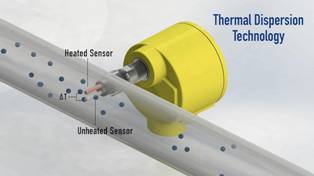
While all thermal flowmeters use heat to make their flow measurements,
there are two different methods for measuring how much heat is dissipated:
·
The constant temperature differential method uses
thermal flowmeters with two temperature sensors: a heated sensor and
another sensor that measures the temperature of the gas. Mass flowrate is
computed based on the amount of electrical power required to maintain a
constant difference in temperature between the two temperature sensors.
·
The constant current method uses thermal
flowmeters with a heated sensor and another one that senses the temperature
of the flowstream. The power to the heated sensor is kept constant. Mass
flow is measured as a function of the difference between the temperatures
of the heated sensor and the flowstream.
Both
methods rely on the idea that greater cooling results from higher velocity
flows. Both measure mass flow based on the measured effects of cooling in
the flowstream.
Popular in water & wastewater treatment
The water and wastewater industry are another key segment driving thermal
flowmeter success. Thermal flowmeters have established themselves in this
industry and are a replacement choice for traditional technologies such as
differential pressure, as they do not introduce pressure drop into the
process flow and require less maintenance.
One of the more common wastewater treatment applications is the measurement
of the air/oxygen gas used to promote the secondary treatment of sludge.
Careful measurement ensures that this step is conducted within ideal
parameters, and that no energy is unnecessarily wasted in pumping more air
or oxygen than the process requires.
Further downstream within a treatment plant, thermal flowmeters can be
found in distribution pipes and aeration basins. And, on heading toward the
output side, the decomposed sludge is exposed to anaerobic treatment using
other specific bacteria chosen for this purpose. The result of this step is
the production of water and a mixture of gases, primarily carbon dioxide
and methane, which thermal meters can measure. Methane, also called
digester gas or biogas, is a growing source of a type of renewable energy.
It has come into use to power on-site plant operations and is also
available as a commercial product.
 Advantages
and limitations Advantages
and limitations
Thermal flowmeters have fast response times and excel at measuring low
flowrates. They can also handle some difficult-to-measure flows and provide
a direct means of measuring mass flow.
One limitation of thermal flowmeters is that they are used almost entirely
for gas flow measurement. They have difficulty measuring liquid flows
because of the slow response time involved in using the thermal principle
on liquids. Some companies, however, have released thermal flowmeters for
liquid flow measurement.
A second limitation is in their accuracy. Thermal flowmeters are not nearly
as accurate as Coriolis meters, and typical accuracy levels are in the one
percent to three percent range. However, thermal suppliers are working to
improve the accuracy of their flowmeters. Expect wider use of thermal
flowmeters as their accuracy levels increase.
Mass flow controllers
One type of thermal flowmeter, a mass flow controller, contains an
integrated control valve that is used to control the flow as well as
measure it. Most mass flow controllers use thermal principles to determine
mass flow, although some use a pressure-based measurement.
The mass flow controller market is one of the most rapidly developing
markets in the flowmeter world today. Mass flow controllers are not
included in this study, although Flow Research has published a separate study on this market.
Articles about Thermal Flowmeters
About
the 2009 Study
Mass Flow Controller Study
All Flowmeter Studies
|